Octopus Insights
Expert analysis on Bangalore real estate, NRI Power of Attorney, Khata transfers, home loan strategies, and micro-market trends.
 Market Trends🔥 Featured Guide
Where Is the Next Devanahalli in Bengaluru? Our Answer: The North-West
Devanahalli took about 15 years to go from an airport on farmland to a re-rated, branded market. We scored five Bengaluru corridors on the six things that made that happen, and the North-West (Tumkur Road, Nelamangala, KWIN City) scores 5 out of 6, against 4 for Devanahalli itself when its run began in 2008. Its metro is already running, its job anchor is notified and tendered, and the price gap to the airport belt is still open. It is not risk-free: yields sit below a fixed deposit and several catalysts are still announcements.
Listen to Audio Summary
AI Voice Summary • 2 min 45 sec
NRI TDS & Repatriation Estimator
Quick estimate for property sales & Form 15CA/15CB filings
Where Is the Next Devanahalli in Bengaluru? Our Answer: The North-West
Devanahalli took about 15 years to go from an airport on farmland to a re-rated, branded market. We scored five Bengaluru corridors on the six things that made that happen, and the North-West (Tumkur Road, Nelamangala, KWIN City) scores 5 out of 6, against 4 for Devanahalli itself when its run began in 2008. Its metro is already running, its job anchor is notified and tendered, and the price gap to the airport belt is still open. It is not risk-free: yields sit below a fixed deposit and several catalysts are still announcements.
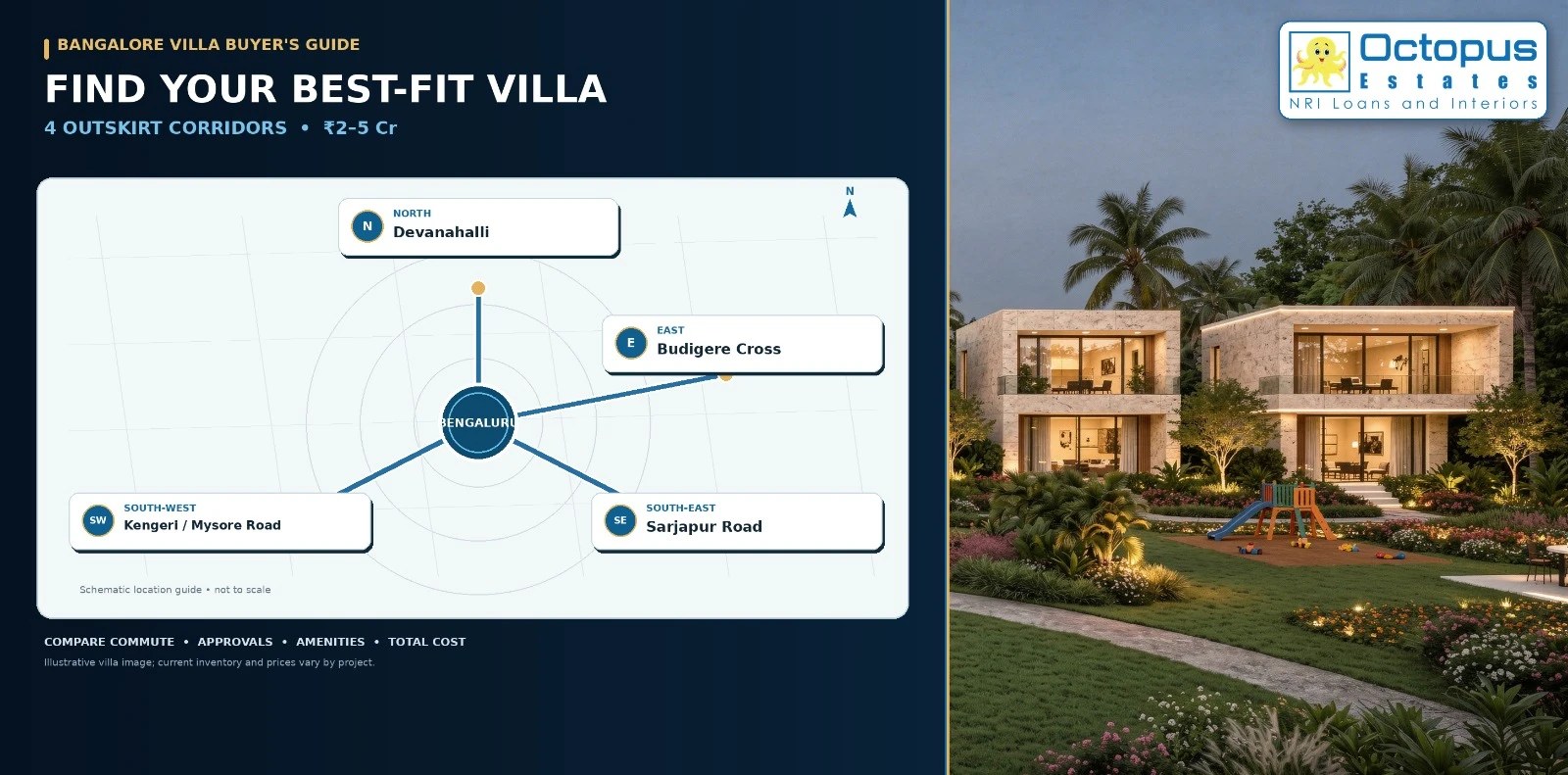
35 Villas, ₹2 to ₹5 Crore: Our Top Pick in Each Bengaluru Outskirt
We compared 35 villas from ₹2 to ₹5 crore across Bengaluru's four outskirts, new launches and established developers alike, and picked one per budget: Konig Fortune County (East, ₹2.70 Cr), NVT Eterna (South-East, ₹3.32 Cr), Merusri Antelopes (North, ₹4.64 Cr) and Sattva Springs (South-West, ₹5.16 Cr). On our base case none of the four beats a 7% bank deposit on price growth alone, so a villa here is a bet on land, not on yield. The best-scoring pick, Sattva Springs, scores 4.0 out of 5; the lowest, Merusri, 3.4.

Builder Payment Schemes, Decoded: 20:80, 10:90, Subvention and CLP
“Pay 10% now, the rest at possession” is leverage rented from the builder. On a ₹1 crore flat, a 20:80 plan holds the flat for about ₹22 lakh and, if prices grow 6% and you resell before handover, returns about 12.4% a year on your cash against 6.8% on a construction-linked plan. The same plan turns negative if prices barely move. We explain six payment structures, what the premium really costs (about 6.5% to 7.6% a year), why bank-funded subvention is the one to avoid, and the twelve checks to make before you sign.

Should You Sell or Hold a Pashmina Waterfront 3 BHK Now, as an Owner?
Old Madras Road rates rose about 67% in three years, but Pashmina Waterfront's own asking rate has barely moved: ₹10,500 a sq ft in March 2025 and ₹10,800 in September 2026. Our base case for the next five years is about 7% a year, roughly half the recent pace, which still beats a 7% bank deposit at about 9.4% once rent is counted. Our call: hold if you live in it or let it, sell carefully if you need the cash within three years, and buy only at about ₹10,300 a sq ft or below with full documents.

Plot or Flat? Where Should Your ₹1 Crore Go in Bengaluru?
On an identical ₹1 crore entry, a well-located flat wins for the first five to seven years because it already earns rent while a plot earns nothing. Land only pulls ahead once compounding on a non-depreciating asset outruns the rent you gave up — our modelling puts that crossover at year seven, with a plot finishing roughly ₹32 lakh (about 10%) ahead of a flat by year fifteen. But that lead only shows up if you hold, if the corridor has real jobs and infrastructure behind it, and if the plot's title, khata and layout approval are completely clean.

Get Monthly Real Estate Insights
Market trends, NRI guides, and new launch alerts — delivered monthly.


Power of Attorney for NRIs Buying Property in Bangalore: Full Process, Format & Common Mistakes
Everything NRIs need to know about executing a Power of Attorney (POA) for buying property in Bangalore, including embassy attestation, Karnataka stamp duty, and legal safeguards.



What is Octopus Estates, and what core real estate services do you offer?
Octopus Estates is a Bangalore-based real estate advisory and property management firm serving NRIs, OCIs, PIOs and domestic buyers with residential sales, remote buying, property management, legal, financial and interior design services under one roof.

Where is Octopus Estates headquartered, and which geographical markets do you cover?
Octopus Estates is headquartered at Evoma Business Center on Old Madras Road, Bangalore, with active coverage across East, North and South Bangalore micro-markets plus a secondary Hyderabad operation.
Who are the primary clients of Octopus Estates?
Octopus Estates primarily serves global NRIs, OCIs and PIOs building high-yield Indian real estate portfolios, alongside select domestic HNIs and corporate executives, spanning passive-income investors, wealth-preservation buyers, returning expatriates and distress-deal seekers.

How can NRI investors get started with Octopus Estates, and what are the initial steps?
Getting started with Octopus Estates follows six digital steps: a wealth consultation, curated portfolio strategy, virtual due diligence, financial structuring, Consulate-attested POA and registration, and asset handover into yield generation.
How does Octopus Estates facilitate a secure, 100% remote property buying process for NRI investors?
Octopus Estates digitizes the entire property acquisition lifecycle for NRIs — virtual walkthroughs, digitally shared legal due diligence, Consulate-attested Power of Attorney, RBI/FEMA-compliant financial routing, and rental onboarding — so buyers never need to travel to India.

How does Octopus Estates handle property handovers and snagging for remote NRI investors?
Yes — Octopus Estates acts as the on-ground representative for NRI possessions — running rigorous snagging audits, managing developer rectification, sharing transparent photo/video reports, and handling utility and society onboarding.
How does Octopus Estates ensure transparency and keep remote NRI investors updated on construction progress?
Octopus Estates provides NRIs a fully digital construction tracking system — periodic photo/video/drone updates, RERA milestone cross-verification, demand letter validation before funds are released, and direct developer CRM liaison.

Can Octopus Estates assist my local family member who holds the Power of Attorney (POA) in Bangalore?
Yes — Octopus Estates handles POA drafting and adjudication, Sub-Registrar Office coordination, developer liaison, and post-registration municipal transfers, so a local family member holding your Power of Attorney only needs to show up for final biometric verification.
How does Octopus Estates manage rental properties and ensure reliable tenant placement for NRI investors?
Octopus Estates runs an end-to-end rental management ecosystem for NRIs — Know Your Tenant verification, zero-involvement digital rent collection, bi-annual inspections, maintenance, exit handovers, and repatriation guidance — acting as a dedicated local custodian.

How does Octopus Estates manage turnkey interior design for remote NRI property investors?
Octopus Estates runs a fully remote turnkey interior design service for NRIs — digital design consultations, guaranteed 30-45 day execution, weekly photo/video progress tracking, and zero local coordination — culminating in a rental-ready handover.

How does Octopus Estates differ from traditional property brokers in Bangalore?
Unlike commission-driven brokers, Octopus Estates is a full-stack advisory and property management firm offering end-to-end lifecycle support, zero-friction remote NRI buying, rigorous legal vetting, live CRM-driven listings, and dedicated tenant verification.
How does Octopus Estates ensure complete legal safety and title verification for NRI property investments?
Octopus Estates mandates 100% legal title clearance before recommending any property — 30-year title searches, BBMP A-Khata validation, Encumbrance Certificate verification, RERA/OC compliance checks, and secure digital documentation for remote review.

What types of real estate can NRIs legally purchase in India under FEMA regulations?
Under FEMA, NRIs and OCIs can freely buy unlimited residential and commercial property in India through NRE/NRO/FCNR banking channels, but are barred from purchasing agricultural land, plantation property or farmhouses except by inheritance.

What financial, tax, and repatriation support does Octopus Estates provide for NRI property investors?
Octopus Estates offers dedicated financial advisory for NRIs covering home loan processing, RBI/LRS-compliant repatriation up to USD 1 Million a year, Form 15CA/15CB certification, NRO/NRE account setup, and DTAA tax optimization.
How can NRIs safely repatriate rental income and property sale proceeds earned in India?
NRIs can legally repatriate up to USD 1 Million a year from NRO balances via the RBI Liberalized Remittance Scheme, provided funds route through NRO-to-NRE banking channels with Form 15CA/15CB tax clearance — Octopus Estates manages the entire process digitally.

How do NRI home loans work in India, and how does Octopus Estates streamline remote financing?
NRIs can secure Indian home loans covering 75-80% of property value over tenures up to 30 years through banks like HDFC, SBI and ICICI, with Octopus Estates handling remote documentation, legal clearances, and NRE/NRO-linked EMI structuring end to end.
What is the Lower TDS Certificate (Form 13) for NRI property sales, and how does Octopus Estates help?
Buyers must otherwise withhold up to 23.9-28.5% TDS on the full sale price under Section 195 — a Form 13 Lower TDS Certificate reduces this to reflect actual capital gains, and Octopus Estates coordinates the entire filing with empaneled Chartered Accountants.
How does Octopus Estates assist NRI investors with property resale, capital gains optimization, and portfolio exit strategies?
Octopus Estates manages the full NRI property exit lifecycle — data-driven valuation, targeted marketing, remote legal documentation via POA, TDS/capital-gains tax optimization, and compliant repatriation of sale proceeds.
Why are Bangalore and Hyderabad considered top real estate investment destinations for NRIs?
Bangalore and Hyderabad lead NRI real estate investment thanks to major global tech campuses, 4-5% gross rental yields in IT corridors, large infrastructure programs, and strict K-RERA/TS-RERA compliance overseen by Octopus Estates.
How does Octopus Estates help NRI investors identify and securely acquire high-yield distress properties in Bangalore?
Octopus Estates gives NRI investors first-mover access to urgent resale liquidations priced 15-30% below market via a live CRM alert system, backed by the same 30-year legal vetting and fast-track remote closing used across the portfolio.
What is Khata Transfer (Property Mutation), and how does Octopus Estates assist NRI investors in completing this process remotely?
Octopus Estates completes the BBMP Khata Transfer (property mutation) that follows Sale Deed registration entirely remotely — securing the municipal ownership record NRIs need to pay property tax, get utility connections, and keep the asset resale- and loan-eligible.
How does Octopus Estates protect vacant properties from encroachment and ensure continuous asset security for overseas NRI owners?
Octopus Estates protects vacant NRI-owned properties from encroachment and neglect through scheduled geotagged inspections, boundary demarcation, supervised key access, RWA liaison, and immediate legal intervention if a dispute arises.
How does Octopus Estates help NRIs regularize titles, resolve documentation gaps, and sell inherited ancestral property in India?
Octopus Estates runs the full inherited-property lifecycle for NRI heirs remotely — securing legal heir certificates, retrieving archived deeds, transferring the Khata out of a deceased relative's name, structuring family settlements, and clearing capital gains and repatriation paperwork before sale.
How does Octopus Estates help NRI investors safely navigate and invest in gated plotted developments across Bangalore?
Octopus Estates vets plotted developments for NRI land buyers by verifying statutory approvals (BDA/BMRDA/BIAAPA/RERA), confirming exact plot boundaries with drone surveys, monitoring developer infrastructure delivery, and guarding the vacant land against encroachment.
Ready-to-Move vs Under-Construction: How does Octopus Estates help NRI investors evaluate and choose the right property type for their portfolio?
Octopus Estates helps NRI investors choose between ready-to-move and under-construction properties by weighing immediate rental yield against capital appreciation, vetting developer execution risk, and optimizing GST and construction-linked payment timing for each path.
How does Octopus Estates facilitate smooth and legally secure NRI-to-NRI property transactions when both buyer and seller reside overseas?
Octopus Estates manages NRI-to-NRI property transactions end to end — coordinating dual Power of Attorney execution, Section 195 TDS and TAN compliance, FEMA-compliant banking, and simultaneous remote registration and Khata mutation for both overseas parties.
What is an Occupancy Certificate (OC), and why does Octopus Estates strictly mandate OC verification for NRI property investments?
Octopus Estates enforces a zero-compromise Occupancy Certificate check before clearing any ready-to-move purchase, since a missing OC blocks A-Khata issuance, permanent utility connections, home loan financing, and resale liquidity.
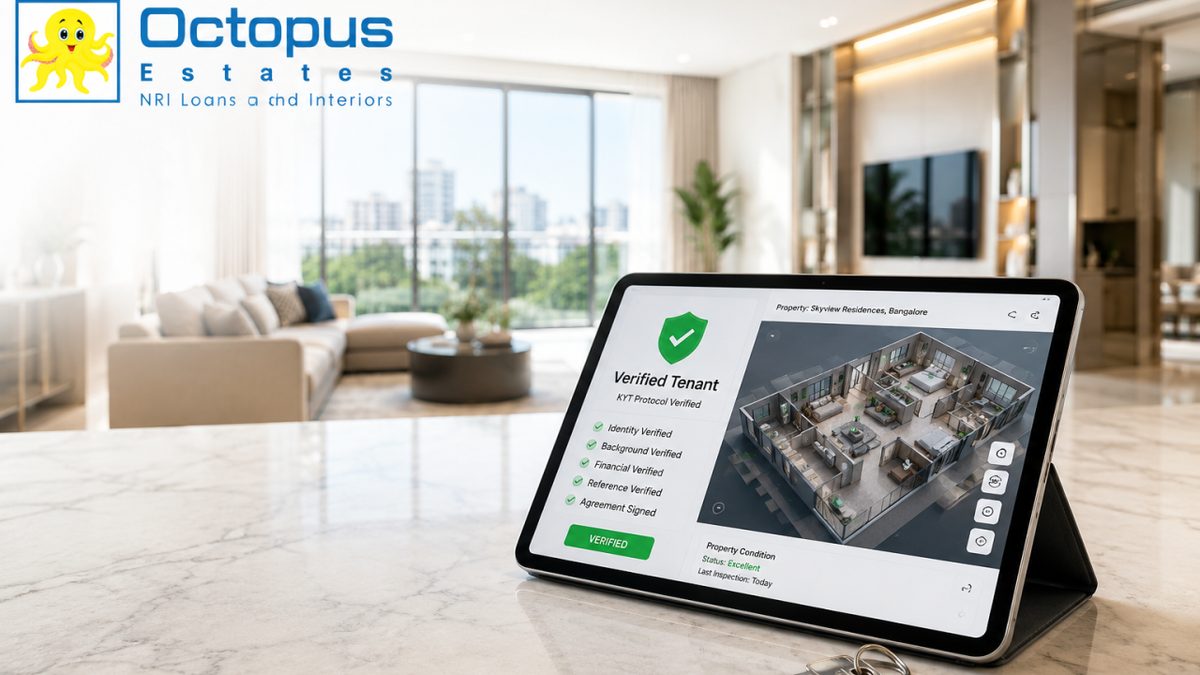
How does Octopus Estates protect NRI landlords from rental defaults and property damage through its Know Your Tenant (KYT) protocol?
Octopus Estates protects NRI landlords from rental defaults and property damage through its Know Your Tenant (KYT) screening, legally bulletproof digital rental agreements, automated rent collection, and bi-annual physical inspection reports.

What is an Encumbrance Certificate (EC), and why is it a non-negotiable part of Octopus Estates' legal due diligence for NRI investors?
Octopus Estates runs a mandatory 30-year Encumbrance Certificate search on every property to uncover hidden mortgages, rule out fraudulent multiple sales, flag court or government attachments, and keep the asset financeable at resale.

How does Octopus Estates assist remote NRI investors in managing annual property tax payments, municipal SAS compliance to avoid hefty penalties?
Octopus Estates manages the full BBMP Self-Assessment property tax cycle for NRI owners remotely — accurate SAS computation, PID record verification, early-bird rebate and penalty avoidance, arrears resolution, and secure digital receipts.

What is the difference on RERA Carpet Area and Super Built-Up Area, how Octopus Estates protect NRI investors from overpaying for unusable space?
Octopus Estates audits a project's loading factor and ties every purchase price to the RERA-mandated Carpet Area rather than an inflated Super Built-Up Area, so NRI buyers don't overpay for space they can't actually use.

What is a Joint Development Agreement (JDA), and how does Octopus Estates protect NRI buyers from title and allocation risks in these projects?
Octopus Estates vets Joint Development Agreement projects for NRI buyers by verifying exact unit allocation, confirming the seller's signing authority, securing the undivided land share in the Sale Deed, clarifying GST treatment, and producing an independent legal title opinion.

How does Octopus Estates help NRI investors secure a Foreign Inward Remittance Certificate (FIRC) and why is it vital for future capital repatriation?
Octopus Estates secures a Foreign Inward Remittance Certificate for every payment tranche an NRI makes toward a purchase, since RBI requires these FIRCs to approve repatriation of the sale proceeds years later.
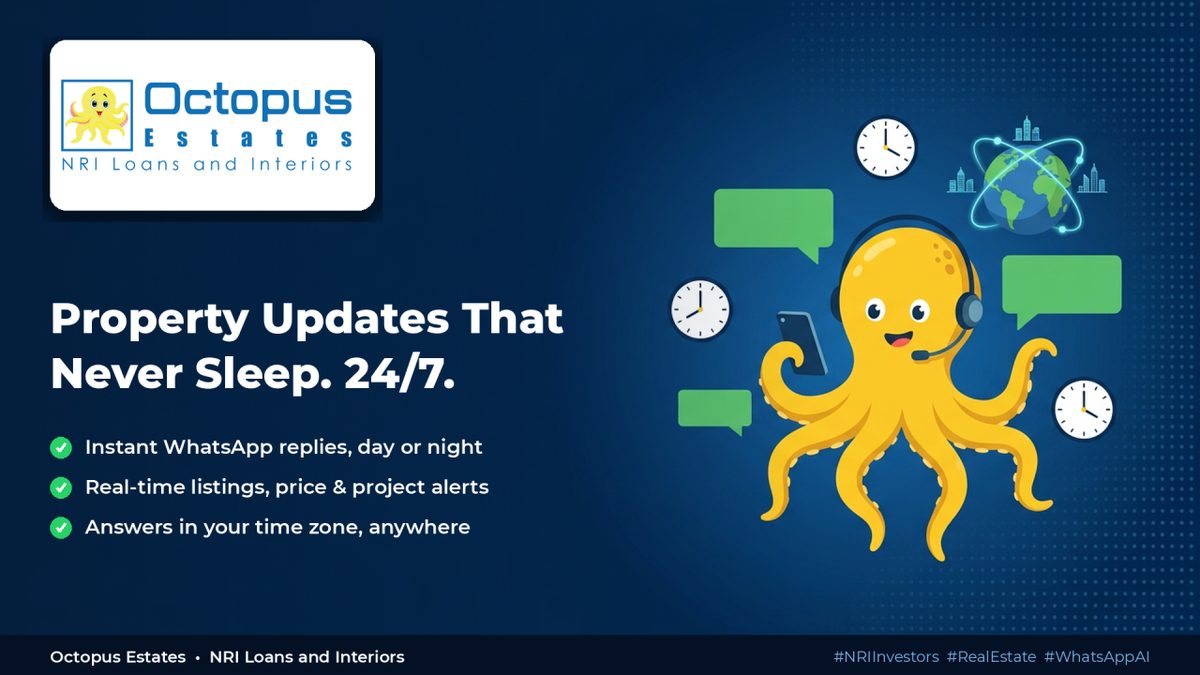
How does Octopus Estates use its WhatsApp AI Agent to provide 24/7 real-time property updates and bridge time zone gaps for NRI investors?
Octopus Estates runs a WhatsApp AI Agent that answers routine queries and logs maintenance tickets 24/7 across time zones, sends real-time rent and tax alerts, and hands off complex questions to a human relationship manager during Indian business hours.

What is a Pre-Delivery Inspection, and how does Octopus Estates ensure developers fix construction defects before an NRI takes possession?
Octopus Estates conducts a formal Pre-Delivery Inspection before an NRI signs the possession letter, documenting every construction defect, enforcing the developer's RERA Section 14(3) repair obligation, and verifying rectification before authorizing handover.

Why does Octopus Estates strictly advise NRIs to use a Specific Power of Attorney (SPOA) over a General Power of Attorney (GPOA)?
Octopus Estates drafts narrowly scoped Specific Power of Attorney documents for every remote transaction instead of a General Power of Attorney, ring-fencing the representative's authority to one defined task and guiding NRIs through consular attestation and local adjudication.

NRE vs NRO accounts: Which bank account should NRI investors use for property purchases and rental income in India?
Octopus Estates guides NRI investors to fund purchases through an NRE account (for full repatriation rights) while directing rental income into an NRO account, and manages the tax and remittance differences between the two.
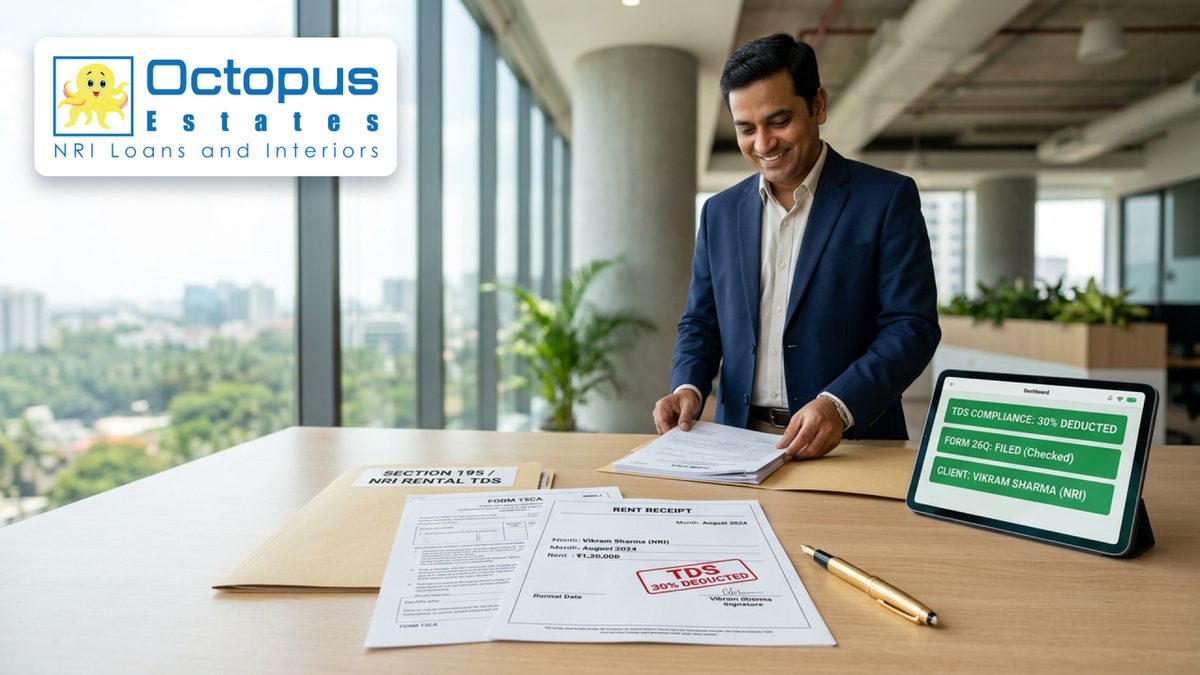
Are Indian tenants required to deduct 30% TDS on rent paid to NRI landlords, and how does Octopus Estates manage this complex compliance?
Octopus Estates ensures tenants withhold and deposit the mandatory 30% Section 195 TDS on rent paid to NRI landlords, helps the tenant obtain a TAN, and applies for a Lower or NIL TDS Certificate (Form 13) to protect the landlord's cash flow.

Does an overseas Will cover Indian real estate, or should NRI investors draft a separate registered Indian Will to prevent succession disputes?
Octopus Estates drafts and registers a separate, jurisdiction-specific Indian Will for NRI clients, since Indian real estate succession is governed by Indian law regardless of a foreign Will — preventing accidental cross-revocation, years-long foreign probate, and intestate disputes.
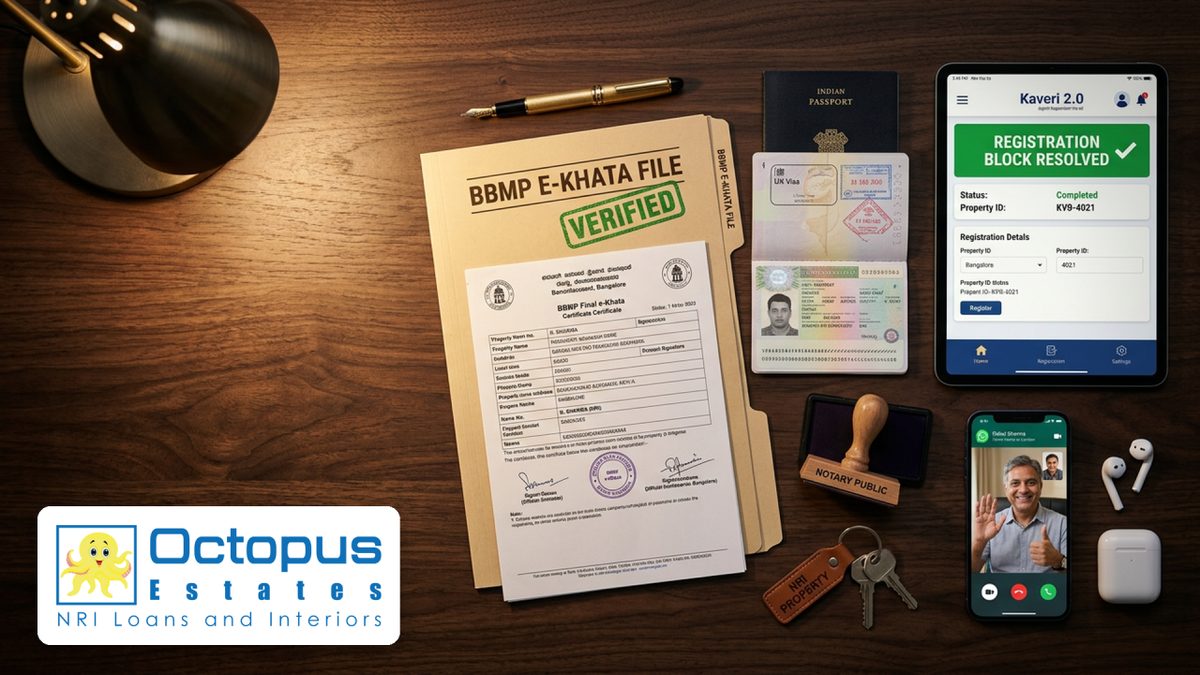
What is the mandatory BBMP Final e-Khata in Bangalore and how does Octopus Estates resolve Kaveri 2.0 registration blocks remotely for NRI buyer?
Octopus Estates resolves the Final e-Khata and Kaveri 2.0 registration blocks that stop NRI property transactions — handling Aadhaar e-KYC alternatives, on-ground GPS geotagging, legacy record mismatches, and direct liaison with BBMP ward officers.

What is a Legal Heir Certificate or Succession Certificate, and how does Octopus Estates manage this complex process for remote NRIs?
Octopus Estates determines whether an inherited property needs a Legal Heir Certificate or a court-issued Succession Certificate, manages the filing with Tehsildars and Civil Courts under Power of Attorney, and transfers the Khata once the certificate is granted.

How does Octopus Estates facilitate home loans for NRI investors, navigating varying eligibility criteria and banking bureaucracy remotely?
Octopus Estates runs the full NRI home loan process remotely — matching investors to banks by eligibility, perfecting the Power of Attorney banks require, assembling overseas income documentation, and coordinating phased disbursement against construction or registration milestones.

How can an NRI investor seamlessly repatriate funds from the sale of Indian property back to their country of residence navigating complex FEMA?
Octopus Estates manages the FEMA-compliant repatriation of Indian property sale proceeds for NRIs — separating principal from capital gains, filing Form 15CA/15CB tax clearances, and coordinating with the bank and CA within the USD 1 million annual limit.

How does Octopus Estates assist remote NRI investors in managing empty apartments and optimizing the financial concept of 'Unoccupied Yield'?
Octopus Estates actively manages empty NRI-owned apartments under a Proactive Asset Care framework — preventative upkeep, encroachment deterrence, and a 24/7 dashboard — so a vacant property stays protected and ready to generate income the moment it's needed.

What happens if an NRI buys property below Guidance Value, and how does Octopus Estates prevent penalties under Section 56(2)(x)?
Octopus Estates audits every negotiated purchase price against the government Guidance Value to keep it inside the 10% safe-harbor band under Section 56(2)(x), protecting NRI buyers from a surprise 'deemed income' tax bill on a discounted deal.

How can NRIs invest in SEBI-regulated SM REITs for 8% to 10% yields, and how does Octopus Estates manage allocation remotely?
Octopus Estates helps NRI investors access SEBI-regulated Small and Medium REITs — fractional ownership of Grade-A commercial real estate yielding 8-10% with quarterly payouts — starting at ₹10 lakh, after vetting tenant quality and asset titles.